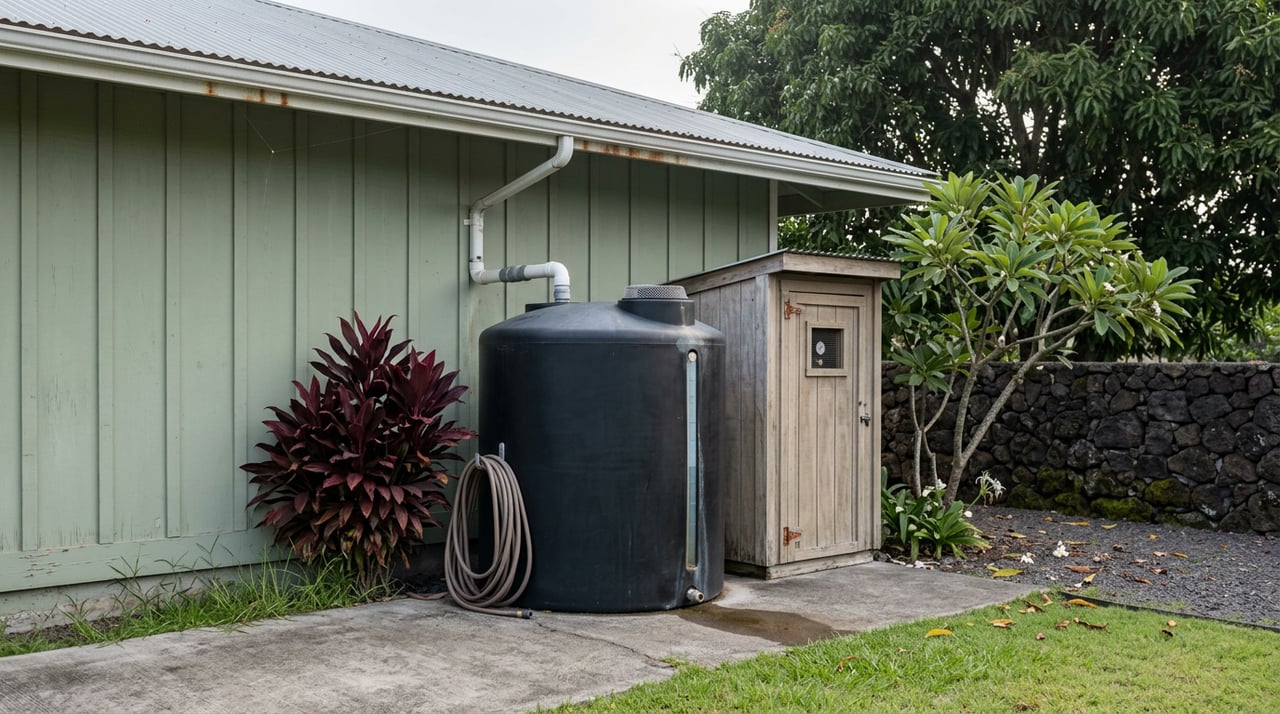
Hawi’s 2025 Water Restrictions: What Buyers Should Ask
August 20, 2026
August 20, 2026
On August 5, 2025, the Department of Water Supply told everyone on the Hawi water system to cut their use by at least a quarter. Puakea Bay. Ka'auhuhu Homesteads. 'Āinakea Village. Every address along Akoni Pule Highway, Mill Road, and Ma'ulili Road. The reason was almost embarrassingly simple: only one of the system's three wells was running. A day later, DWS tightened the order again, down to essential needs only, drinking, cooking, hygiene, because Hawi Well No. 1 was carrying the entire town alone while Hawi Well No. 2 sat offline for emergency repair. A water tanker got parked at the intersection of Hawi Road and Kohala Mountain Road so people could fill jugs.
If you'd told a buyer shopping Hawi that summer that the town runs on county water, they'd have pictured something closer to a mainland subdivision: turn the tap, water comes out, someone else worries about the source. What actually happened in August 2025 is the more honest picture. A small groundwater system with a thin margin for error had one bad week, and an entire town felt it.
The Hawi Water System draws from Hawi Well Nos. 1 and 2 and the Halaula Well, all groundwater sources that also feed the adjoining Halaula system. That's the whole supply. Three wells for a service area that stretches along Akoni Pule Highway from Puakea Bay Drive in the west to Kapaau Road. When one well needs unplanned repair, as Hawi Well No. 2 did last August, the system doesn't have much slack to absorb it. That's why a single mechanical failure turned into a systemwide restriction notice rather than a quiet maintenance ticket.
This matters for anyone comparing Hawi to a neighborhood on a larger municipal system. The math isn't about whether the water is safe (DWS reported meeting all EPA and state drinking water standards for the year). It's about how many wells stand between a normal Tuesday and a restriction notice. In Hawi, the answer is small enough that it happened within the past year, on the record, with a name and a date attached.
Ask five people whether North Kohala is "on catchment" and you'll get five different answers, mostly because the question assumes a single answer exists. It doesn't. The Hawi Water System has a defined service corridor. Step outside that corridor, onto a rural homestead lot a few minutes up the road, and you're often looking at a well or a rain catchment tank instead, because the county mains simply don't reach that far.
Two lots that look identical on a map, both a short drive from downtown Hawi, both listed as "North Kohala," can carry entirely different water realities. One might have a meter and a monthly bill. The other might depend on however much rain fell that season. Neither status is printed anywhere obvious. It has to be asked, parcel by parcel, of the Department of Water Supply directly.
| Inside the Hawi Water System | Outside the service corridor | |
|---|---|---|
| Water source | Hawi Well Nos. 1 and 2, Halaula Well | Private well or rain catchment |
| Monthly cost | County water bill | No bill, or tank refill costs during drought |
| Supply risk | Tied to well operational status | Tied to rainfall and tank size |
| What August 2025 showed | A single well outage triggered a restriction across the corridor | Not directly affected by the DWS notice |
Neither column is the "safe" one. They're just different failure modes, and a buyer who only asks "catchment or county" without asking where the line actually falls is asking the wrong question.
Here's the part that would have surprised a Hawi buyer even a year ago. Until this summer, a property with an existing county water meter generally couldn't legally add a rainwater catchment system as backup, because most county rules treated catchment as an either-or proposition rather than a supplement, according to The Garden Island. That changed on July 1, 2026, when HB1728 took effect statewide as Act 209, according to the Governor's Office. Governor Green signed it on July 8, 2026, alongside a package of housing and infrastructure bills. LegiScan says Act 209 requires every county in Hawai'i, including Hawai'i County, to allow rainwater catchment systems for both potable and nonpotable use on any property, even one already served by a county meter. Counties can still require registration or inspection of a catchment system, but they can no longer forbid it just because a meter exists.
For a Hawi buyer, that's a real shift in what's available. A year ago, if you bought a metered home in town and wanted a backup tank in case Hawi Well No. 2 went down again, you were often out of luck. Now that backup is a legal option to design into a purchase or a renovation, not a workaround.
Some Hawi property owners were ahead of the law. A residence on Ka'auhuhu Homestead Road, listed with the property's own agricultural potential in mind, describes service by two county water connections and a 2,500-gallon water catchment tank. That's a metered home that also kept a catchment tank running, treating the two systems as complementary rather than a choice between them. Now it's exactly the model the new law is built to support statewide.
That single listing is a useful preview of where more Hawi properties may head. If the well failures of August 2025 taught anyone anything, it's that a metered address isn't automatically a worry-free one, and the smartest sellers in town are the ones who already hedged.
None of these questions show up on a listing sheet. They come from knowing that "Hawi" and "on county water" aren't the same claim, and that the system backing that claim had a documented bad week less than a year ago.
Is Hawi on catchment or county water? Both, depending on the parcel. The town core along Akoni Pule Highway, from Puakea Bay Drive to Kapaau Road, is served by the Hawi Water System. Rural homestead lots outside that corridor often rely on catchment or private wells instead.
What actually happened with Hawi's water in 2025? On August 5, 2025, DWS issued a 25 percent water restriction for the Hawi water system because only one of its three wells, Hawi Well No. 1, was operational while Hawi Well No. 2 underwent emergency repair. The notice tightened to essential needs only the next day and was lifted once repairs were completed.
Can I add a catchment tank if my Hawi home already has a county meter? As of July 1, 2026, yes. Act 209 requires Hawaii County to allow rainwater catchment systems on any property, including metered ones, though the county can still require registration or inspection.
Water questions in North Kohala rarely have a one-word answer, and pretending they do is how buyers end up surprised. If you're looking at a property in Hawi and want someone who'll actually call the Department of Water Supply and ask the parcel-specific question instead of repeating a general rule, that's the kind of groundwork Denni Keyes does before you ever write an offer. Let's Connect.
This article is general information, not legal, tax or financial advice. Consult a qualified professional about your situation.
Stay up to date on the latest real estate trends.




I'm not just a real estate agent — I'm a neighbor, a parent, and a proud member of this island community. My commitment to communication, integrity, and purpose means you'll always have a trusted partner by your side throughout your real estate journey.

69-201 Waikoloa Beach Dr Ste 505 Waikoloa, HI 96738