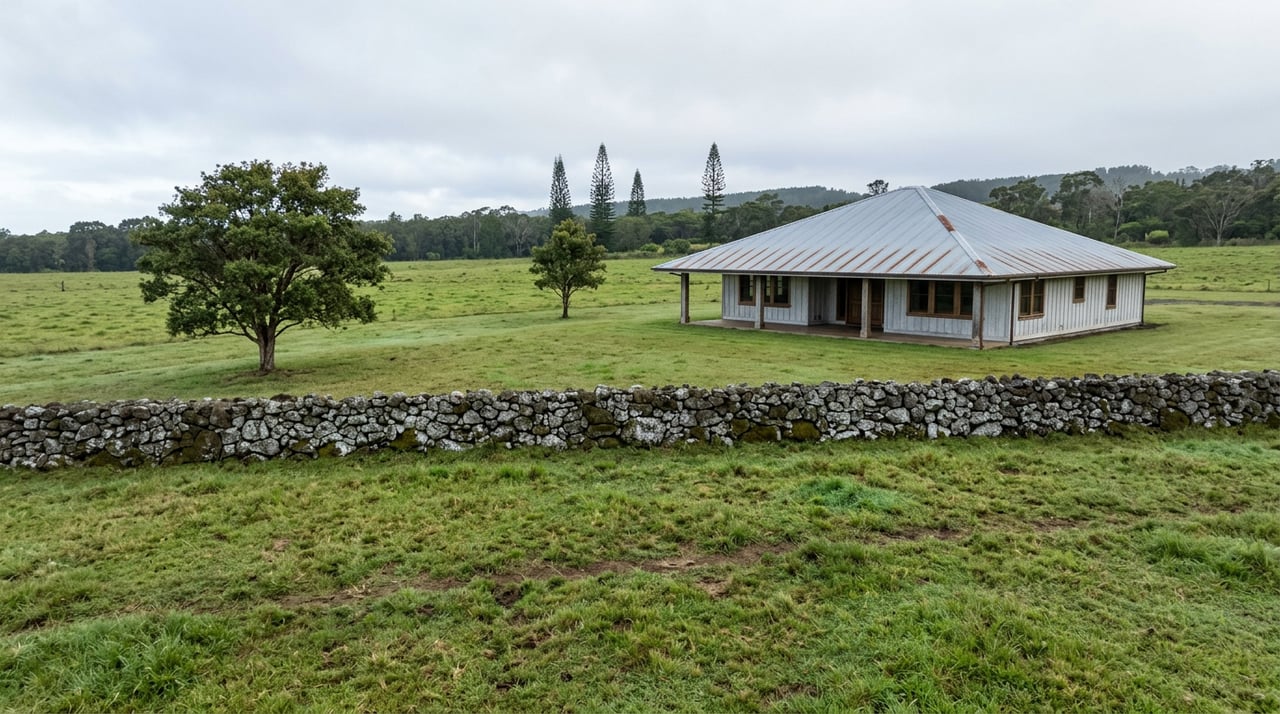
The Low Tax Bill on a Kamuela Ranch Listing Isn't a Perk. It's a Contract You're Inheriting.
September 3, 2026
September 3, 2026
"We wanted to ensure that folks that were getting the tax breaks for farming, for doing agriculture, were actually doing farming and agriculture."
A Hawai'i County councilmember said that during a hearing earlier this year, explaining why the county's long-running non-dedicated agricultural tax program is being phased out this September. If you're looking at ranch or pasture land around Kamuela or Waimea right now, that sentence matters more than it sounds like it should. The number sitting on a listing sheet next to "annual property tax" isn't just a fact about the land. Depending on which program produced it, that number can be a recorded legal commitment, and it may already be attached to the title, waiting to become the new owner's problem the day escrow closes.
Kohala and Waimea ranch land trades in a wide range, anywhere from roughly $2 million into the tens of millions for parcels running from around 50 acres up past 1,000. A lot of that land carries a property tax bill that looks almost too good to be true next to the sale price. It usually is exactly what it looks like: a legitimate, county-sanctioned agricultural assessment. What buyers often don't ask, and what sellers sometimes forget, is what has to keep happening on that land for the number to stay that low, and what happens to whoever owns the property if it stops.
Hawai'i County currently runs three ways to get agricultural land assessed at something closer to its farming value than its market value, plus a fourth option that's being retired this year. The distinctions matter because they carry different lock-in periods, different documentation requirements, and different exposure if the agricultural use ever stops.
| Program | Commitment | How it's assessed | Filing window |
|---|---|---|---|
| Non-dedicated ag use (phasing out) | Annual renewal, no long-term lock-in | Ag-use value, reviewed each year | Being phased out as of September 2026 |
| 3-Year Dedicated | 3-year commitment | Full ag-use value per acre by category | September 1 preceding the tax year |
| 10-Year Dedicated | 10-year commitment, recorded at the State Bureau of Conveyances | Roughly half the 3-year per-acre value | September 1 preceding the tax year |
| Community Food Sustainability | Variable, newer program | 30% of market value, used when the dedicated-use value would otherwise exceed market value | Different annual window (typically calendar year) |
The county's own numbers show the gap between the short-term and long-term dedicated categories is real, not cosmetic. Fruit and nut orchards, for example, are valued around $3,000 per acre under the 3-year program and about $1,500 per acre under the 10-year program. Pasture and grazing categories, which is what most Kamuela and Waimea ranch acreage falls under, are valued under their own schedule, but the same 50 percent discount structure applies: commit longer, get assessed lower.
One Hawai'i Island landowner who wrote about the mechanics of the program put a number on what this looks like in practice: land the county valued at roughly $480,000 on the open market carried a dedicated-use value of about $25,000. That is the kind of gap that makes ranch ownership pencil out here, and it's also the kind of gap that should make anyone buying into it ask exactly what they're agreeing to keep doing.
"It also has a larger intent, to make sure that we don't have speculation happening on agricultural land, which is one of the things that drives prices up."
That's the same councilmember, explaining the broader reason the county tightened these rules after a 2024 audit found the previous oversight wasn't catching landowners who held the tax benefit without doing much actual farming or ranching. The council's response wasn't a warning. It was a program elimination, an application deadline, and a bill that offers no refunds for past years and sunsets at the end of 2029.
Two things end an agricultural dedication faster than anything else, and neither is obscure once you know to look for them.
None of these are unusual asks for genuine working ranches. They become a problem only for land that has been coasting on paperwork from a previous owner's operation.
Here's the mechanism that catches people off guard at the closing table. A 10-year dedication has to be recorded at the State of Hawai'i Bureau of Conveyances. That recording shows up on a preliminary title report, the same way an easement or a boundary agreement would. It does not expire when the property changes hands. If a buyer closes on a ranch mid-dedication and then decides not to continue the agricultural use, the tax break doesn't just disappear going forward. It can trigger rollback taxes, calculated as if the preferential assessment had never applied, going back through the years of the commitment.
That's the piece a lot of buyers miss, because a title report reads like a background document, not a to-do list. A recorded ag dedication is both. It tells you the previous owner's tax bill was low for a reason, and it tells you that reason is now legally yours to keep honoring, or expensively yours to unwind.
The 3-year dedication carries less of this exposure since it isn't required to be recorded the same way, but it still requires the same proof of ongoing use to keep the lower assessment year over year.
If you're buying ranch or pasture acreage around Kamuela or Waimea this year, ask your escrow officer or title company to confirm whether a dedication is recorded against the parcel, what category it falls under, and what documentation the current owner has been filing. Don't assume the low tax line is permanent. Ask what it would take to keep it, and what it would cost to walk away from it.
If you're selling land currently enrolled in the non-dedicated program, the September 1, 2026 deadline is the one to watch. The county has been mailing notices to landowners still in that program, and once the option is gone, the choice narrows to the 3-year or 10-year dedicated programs, or the Community Food Sustainability option if the numbers favor it. Deciding which one to file under, and whether to do it before or after a sale, changes what a buyer inherits and what your net proceeds actually look like.
None of this makes ranch land around Kamuela a harder buy than it already is. It just means the tax line deserves the same scrutiny as the water source and the fencing. It's not a fixed fact about the property. It's a standing agreement, and somebody has to keep it.
Does a low ag tax bill mean the land legally has to stay agricultural forever? No. It means the current assessment depends on continued agricultural use and proof of it. The land itself can be converted to another use, but doing so while a dedication is active, especially a recorded 10-year one, can trigger rollback taxes.
Can I keep a few horses on dedicated land without running a full operation? The county's documentation requirements look for demonstrable, continuous agricultural use, typically shown through a farm plan or similar record. A handful of horses without any operational plan is unlikely to satisfy that on its own, though equestrian properties with proper facilities and plans are common across Waimea and upper Kohala.
Can I run a short-term rental on ag-zoned Kamuela land and keep the tax benefit? Generally no. Rental stays under 180 days are treated as disqualifying for the agricultural dedication, consistent with the state's broader limits on transient vacation rentals in agricultural districts.
What if I buy dedicated land and simply don't want to farm it? That's a conversation to have before closing, not after. A title search will show whether a dedication is recorded, and a conversation with the county's Real Property Tax Division can clarify what ending it would cost. Buying with your eyes open here is far cheaper than unwinding a commitment you didn't know you'd taken on.
Ranch and pasture transactions around Kamuela come with more moving parts than the median price ever shows. If you're weighing a purchase or a sale on ag-zoned land here, Denni Keyes has spent more than a decade on the title and escrow side of exactly these questions. Let's Connect.
Stay up to date on the latest real estate trends.
I'm not just a real estate agent — I'm a neighbor, a parent, and a proud member of this island community. My commitment to communication, integrity, and purpose means you'll always have a trusted partner by your side throughout your real estate journey.
69-201 Waikoloa Beach Dr Ste 505 Waikoloa, HI 96738