Kapaau's Smallest Lots Can't Be Recreated. Some Can't Fit a Septic System Either.
August 13, 2026
August 13, 2026
Before you write an offer on a small in-town lot in Kapaau, there is a question worth asking before you ask about the roof or the kitchen: where would a septic system actually go.
It sounds like a small thing. It isn't. The same quality that makes Kapaau's plantation-era lots valuable, their size and their scarcity, is the same quality that can make a state-mandated wastewater upgrade genuinely difficult to complete on them. That tension doesn't show up on a listing sheet. It shows up during due diligence, and by then it's already shaping the negotiation.
Kapaau's small parcels hold value in part because a 20-acre agricultural zoning minimum means nobody can carve a new lot that size out of the surrounding land again. That scarcity is real and it's durable. But the same in-town lots that were platted before modern wastewater infrastructure existed were also, in many cases, built with a cesspool: a lined pit in the ground that lets untreated sewage seep directly into the soil. Hawaii banned construction of new cesspools in 2016, and a 2017 state law, Act 125, requires every existing cesspool in the state to be upgraded, converted, or connected to sewer by January 1, 2050. That deadline applies whether the lot is a quarter-acre or twenty acres. The lot size doesn't change the law. It changes what compliance actually requires on the ground.
Hawaii Island carries more of this problem than any other county in the state. A 2023 Hawaii County Council briefing put the island's total at roughly 48,600 cesspools still needing conversion, more than any other island, and the county's own environmental management director told council members at the time that the county "hasn't even started" a coordinated conversion effort, according to reporting by Big Island Now.
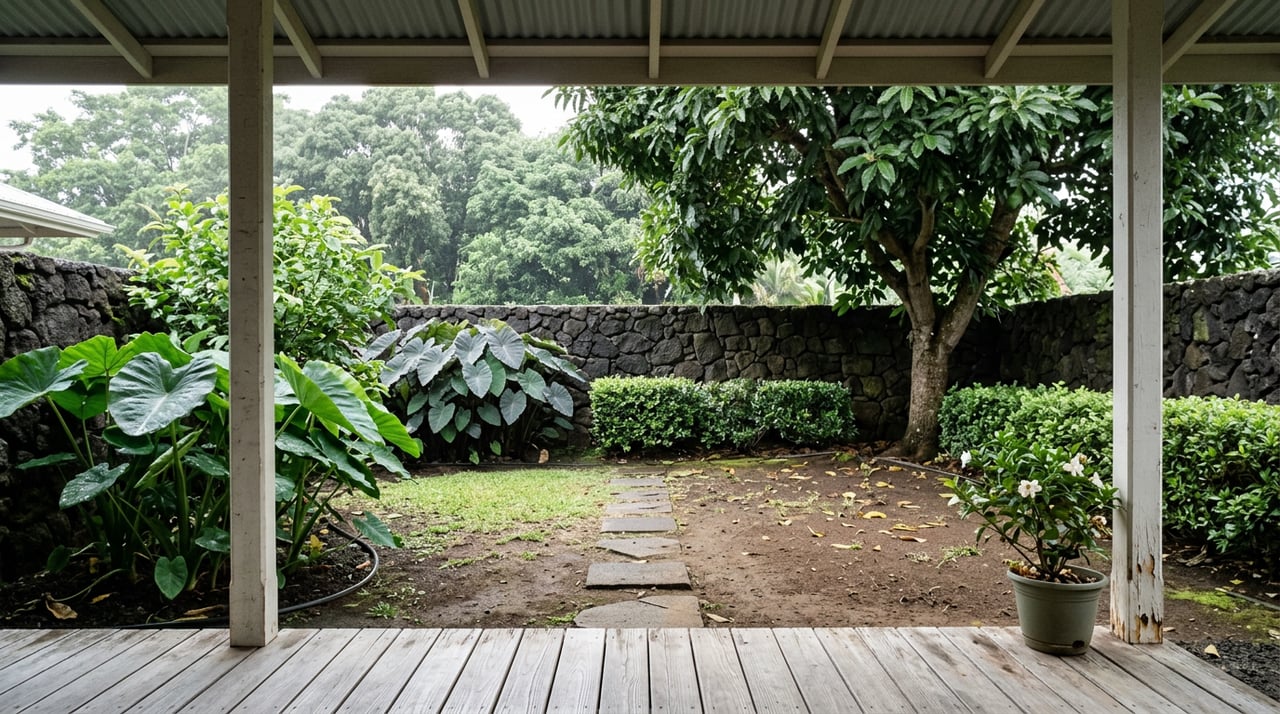
A conventional septic system isn't just a tank. It needs a tank site plus a leach field, and that combination typically requires somewhere between 1,000 and 2,000 square feet depending on soil conditions, often requiring tree clearing, grading, or rock excavation on lava-influenced sites. On a spacious rural acre, that's a solvable siting problem. On a tight, established in-town lot in Kapaau, where the house, the driveway, mature fruit trees, and a dooryard garden may already occupy most of the usable ground, it can be the hardest part of the entire conversion.
Where a conventional leach field genuinely won't fit, homeowners often need an aerobic treatment unit instead. These systems use powered blowers to treat wastewater more aggressively before it's released, which lets them work on tighter or more constrained sites, but they also require ongoing maintenance and electricity to run, a real ongoing cost that a simple leach field doesn't carry.
House Speaker Nadine Nakamura put the core affordability problem plainly at a bill-signing ceremony this July:
"What happens when 80% to 90% of the families in Hawaii cannot afford the cost of the $30,000 to $50,000 it may take?"
That range shows up consistently across cost estimates for a standard conversion, and it climbs from there on a difficult site. A small in-town lot that needs an aerobic system instead of a conventional one, or that needs significant excavation to make a leach field fit, tends to land at the higher end of that range, not the lower one.
Hawaii sellers don't get to defer this conversation to closing. Under Hawaii Revised Statutes Chapter 508D, every seller of residential property must complete a Seller's Real Property Disclosure Statement, and cesspool status is one of the specific items the form asks about, including whether the cesspool serves more than one dwelling or living unit. A cesspool shared across multiple homes or ohana units, sometimes called a gang cesspool, isn't permitted under current regulations, which matters directly for Kapaau's older, sometimes multigenerational properties.
The disclosure timeline runs on a fixed clock once a purchase contract is accepted:
A cesspool that a buyer's engineer flags as difficult or expensive to convert on a small lot is exactly the kind of fact that can surface during that window, sometimes after an offer has already been accepted.
One month ago, on July 8, 2026, Governor Josh Green signed House Bill 1618, now Act 204, creating Hawaii's first Cesspool Conversion Revolving Loan Fund. The measure, introduced by Kona Representative Nicole Lowen and administered by the Hawaii Green Infrastructure Authority, offers low-interest or potentially forgivable loans to help homeowners cover conversion costs. It's a real, new tool, and it's the first financing mechanism the state has built specifically for this problem.
It's also modest relative to the scale of the need. The initial allocation is $2 million, described at the signing as seed money, against a statewide estimate of roughly $2.4 billion to convert all of Hawaii's more than 80,000 remaining cesspools if the work were done today, according to reporting in West Hawaii Today. For a Kapaau buyer or seller, that means the fund is worth asking about, but it isn't yet a reason to assume subsidized financing will be readily available for a specific property in the near term.
Fellow Hawaii Life agent Beth Thoma Robinson went through a cesspool-to-septic conversion on her own property in Hawi, up the coast in North Kohala, and wrote about the experience firsthand. When a reader compared notes with Honolulu quotes running from $120,000 to $464,000, she was clear that her own installation in Hawi came in well below those numbers and was representative of what most homeowners here actually experience, closer to the tens of thousands, not hundreds of thousands, that urban Oahu sites can run.
For a Kapaau property still on a cesspool, a few concrete steps change the conversation from guesswork to a plan:
None of this makes Kapaau's small lots less worth wanting. It makes the wastewater question part of the same due diligence that any serious buyer or seller already does on price, condition, and title. The lots that can't be recreated are worth protecting with a clear-eyed look at what they'll actually need to bring into compliance, and on whose timeline.
If you're weighing a small lot in Kapaau, on either side of the transaction, I'd rather walk through what a specific property's cesspool status means for your offer or your listing before it becomes a surprise in escrow. Reach out to Denni Keyes and Let's Connect.
Stay up to date on the latest real estate trends.
I'm not just a real estate agent — I'm a neighbor, a parent, and a proud member of this island community. My commitment to communication, integrity, and purpose means you'll always have a trusted partner by your side throughout your real estate journey.
69-201 Waikoloa Beach Dr Ste 505 Waikoloa, HI 96738